

One of the greatest advantages of digital commerce is the vast selection of products available to consumers. Retailers can offer thousands or even millions of SKUs across multiple categories, giving shoppers unprecedented choice and convenience. However, while variety can enhance the customer experience, too many options can also create a significant challenge: choice overload.
Choice overload occurs when customers are presented with so many alternatives that making a decision becomes difficult. Instead of feeling empowered by abundant options, shoppers may feel overwhelmed, uncertain, or frustrated. This often leads to longer decision-making cycles, abandoned shopping sessions, lower conversion rates, and missed revenue opportunities.
As ecommerce catalogs continue to expand, helping customers navigate product choices efficiently has become a critical business priority. This is where product recommendation engine play an essential role. By leveraging customer data, behavioral insights, artificial intelligence (AI), and machine learning, recommendation engines help shoppers discover products that are most relevant to their needs and preferences.
Rather than forcing customers to evaluate hundreds of potential options, recommendation engines narrow the decision set and guide shoppers toward products they are more likely to purchase. In doing so, they improve customer experiences, accelerate product discovery, and support stronger business outcomes.
As digital commerce becomes increasingly complex, recommendation engines are emerging as one of the most effective tools for reducing choice overload and simplifying customer decision-making.
Understanding Choice Overload
Choice overload refers to the phenomenon where an excessive number of options makes decision-making more difficult.
When customers encounter too many alternatives, they may experience:
- Decision fatigue
- Increased uncertainty
- Reduced confidence
- Delayed purchases
- Purchase abandonment
While consumers appreciate having options, they often prefer curated experiences that simplify choices.
This is particularly true in categories with large product assortments.
Why Choice Overload Is Growing in Ecommerce
Several factors contribute to increasing choice overload.
Expanding Product Catalogs
Retailers continually add products to meet customer demand and expand market reach.
Marketplace Growth
Many ecommerce platforms aggregate products from multiple sellers.
Omnichannel Assortments
Retailers often offer different inventory across channels.
Personalized Shopping Expectations
Customers expect retailers to help them navigate options efficiently.
As assortments grow, discovery and decision-making become more challenging.
The Business Impact of Choice Overload
Choice overload affects both customers and retailers.
For customers, it can lead to:
- Frustration
- Longer shopping sessions
- Reduced satisfaction
- Purchase hesitation
For retailers, it often results in:
- Lower conversion rates
- Increased bounce rates
- Cart abandonment
- Reduced average order value
Helping customers make decisions more confidently therefore has a direct impact on business performance.
What Is a Product Recommendation Engine?
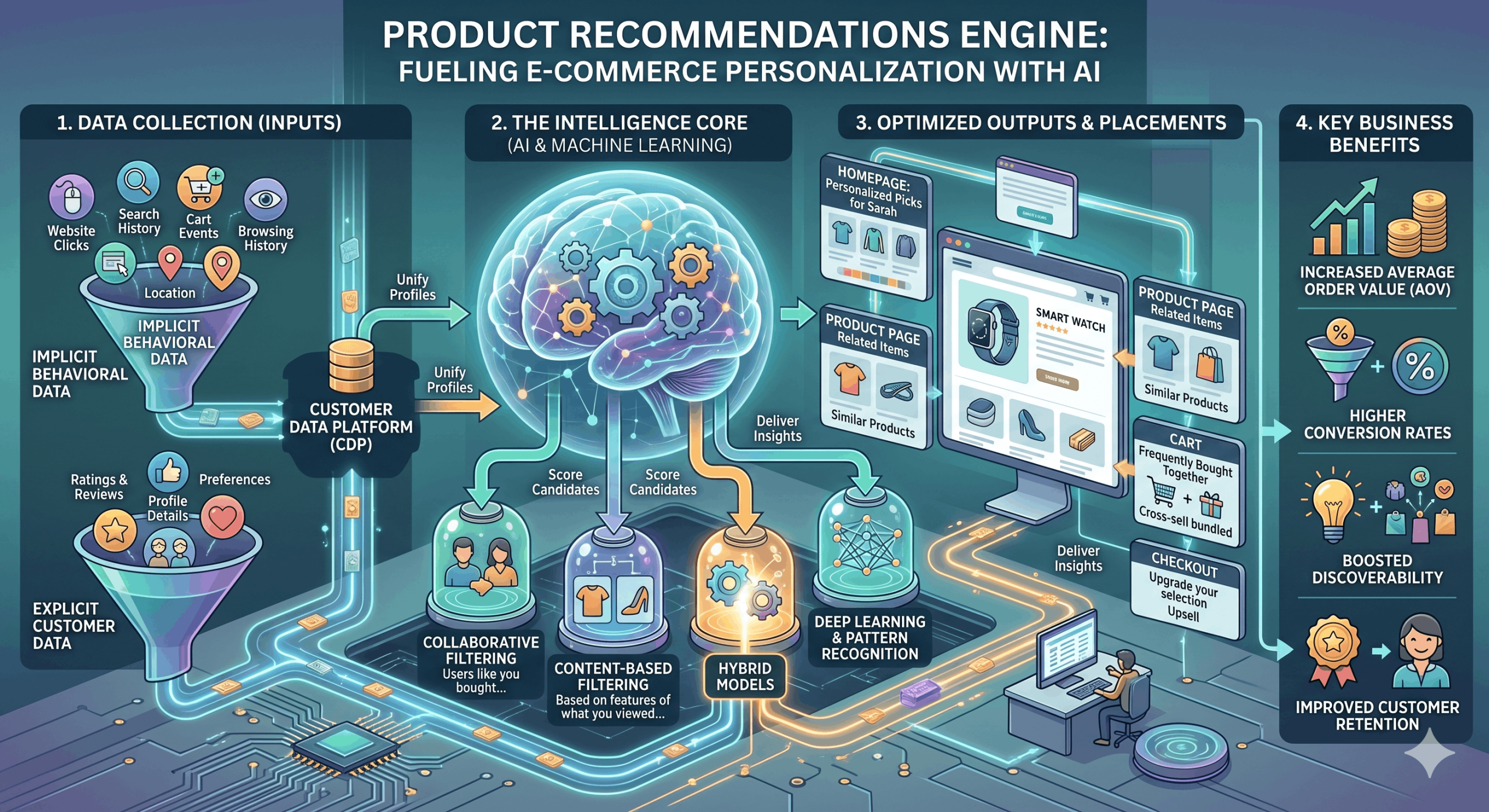
A product recommendation engine is a technology system that analyzes customer data and behavior to suggest products that are most relevant to an individual shopper.
Recommendation engines use inputs such as:
- Browsing behavior
- Purchase history
- Search activity
- Product affinity patterns
- Customer preferences
The objective is to surface products that align with customer interests and intent.
Modern recommendation engines increasingly rely on AI and machine learning to improve relevance and scalability.
Why Recommendation Engines Are Effective Against Choice Overload
Recommendation engines reduce the cognitive burden associated with evaluating large numbers of products.
Instead of requiring customers to browse extensive catalogs, recommendation engines identify a smaller set of highly relevant options.
This makes decision-making easier and more efficient.
The result is a more satisfying shopping experience.
How Product Recommendation Engines Reduce Choice Overload
Personalizing Product Discovery
Every customer has unique preferences, needs, and interests.
Recommendation engines analyze customer behavior to present personalized product suggestions.
These recommendations are often based on:
- Browsing history
- Purchase behavior
- Product interests
- Customer affinity patterns
Personalization narrows the range of options customers need to evaluate.
This reduces decision fatigue.
Leveraging Customer Intent Signals
Intent signals help recommendation engines understand what customers are interested in at a specific moment.
Examples include:
- Product views
- Search queries
- Category exploration
- Cart additions
- Wishlist activity
These signals help recommendation engines prioritize products that align with current customer needs.
This improves relevance and simplifies choices.
Surfacing Relevant Products Faster
Large product catalogs can make discovery difficult.
Recommendation engines accelerate discovery by highlighting:
- Relevant products
- Similar products
- Complementary products
- Trending items
Customers spend less time searching and more time evaluating meaningful options.
Guiding Customers Through Decision-Making
Many shoppers need assistance comparing alternatives.
Recommendation engines can guide decisions by presenting:
- Best-selling products
- Popular choices
- Personalized rankings
- Frequently purchased products
These recommendations provide valuable decision support.
Reducing Search Friction
Search results often contain dozens or hundreds of products.
Recommendation engines help prioritize the most relevant items within these results.
This reduces the effort required to find suitable products.
Customers can reach purchasing decisions more quickly.
Supporting Product Discovery for Large Catalogs
Retailers with extensive assortments face greater choice overload challenges.
Recommendation engines help manage this complexity by:
- Filtering irrelevant options
- Prioritizing customer interests
- Highlighting products with higher purchase likelihood
This improves catalog navigation and discovery.
Enhancing Category Browsing
Category pages often contain hundreds of products.
Recommendation engines personalize category experiences by:
- Reordering products
- Highlighting preferred brands
- Promoting relevant items
This creates more focused and manageable shopping experiences.
Encouraging Confidence in Purchase Decisions
Customers are more likely to complete purchases when they feel confident in their choices.
Relevant recommendations reduce uncertainty by demonstrating:
- Product relevance
- Similar customer preferences
- Popular purchasing patterns
This strengthens decision confidence and improves conversions.
Supporting Anonymous Shopper Experiences
Not all customers are logged in.
Recommendation engines can still reduce choice overload using session-based behavioral signals such as:
- Product views
- Search activity
- Browsing patterns
This helps create relevant experiences from the first interaction.
AI and Machine Learning Improve Recommendation Quality
Artificial intelligence enables recommendation engines to analyze vast amounts of customer and product data.
AI can:
- Identify preference patterns
- Predict product relevance
- Detect emerging interests
- Optimize recommendation rankings
Machine learning continuously improves recommendation accuracy over time.
This creates increasingly effective product discovery experiences.
Omnichannel Choice Reduction
Customers engage across multiple channels, including:
- Ecommerce websites
- Mobile applications
- Email campaigns
- Loyalty platforms
Recommendation engines help maintain consistent product guidance across these touchpoints.
This supports more seamless customer journeys.
The Role of Customer Data Platforms
Customer Data Platforms (CDPs) strengthen recommendation engines by providing unified customer profiles.
A CDP consolidates:
- Purchase history
- Browsing behavior
- Search activity
- Loyalty engagement
- Customer preferences
These insights improve recommendation relevance and personalization.
Benefits of Recommendation Engines for Reducing Choice Overload
Faster Product Discovery
Customers find relevant products more quickly.
Reduced Decision Fatigue
Fewer options need to be evaluated.
Improved Customer Satisfaction
Shopping becomes easier and more enjoyable.
Higher Conversion Rates
Relevant recommendations support purchasing decisions.
Increased Average Order Value
Cross-sell and upsell opportunities become more effective.
Stronger Customer Retention
Positive shopping experiences encourage repeat engagement.
Common Challenges Retailers Face
Large Product Catalogs
Managing relevance becomes increasingly difficult.
Data Fragmentation
Customer information may reside across multiple systems.
Real-Time Personalization Requirements
Customer intent changes rapidly.
Recommendation Scalability
Retailers must personalize experiences for large audiences.
Addressing these challenges is critical for success.
Best Practices for Reducing Choice Overload with Recommendation Engines
Leverage Real-Time Behavioral Signals
Current customer actions provide valuable context.
Use AI-Powered Recommendation Models
Machine learning improves personalization accuracy.
Prioritize Relevance Over Quantity
Fewer highly relevant recommendations often perform better.
Continuously Optimize Recommendation Performance
Customer preferences evolve over time.
Integrate Recommendations Across the Customer Journey
Personalized guidance should occur throughout the shopping experience.
Key Metrics to Track
Organizations should monitor:
- Recommendation click-through rates
- Conversion rates
- Average order value
- Product discovery metrics
- Customer engagement rates
- Revenue per visitor
- Repeat purchase rates
These indicators help evaluate recommendation effectiveness.
How Algonomy Helps Reduce Choice Overload
Algonomy’s AI-powered Product Recommendation Engine helps retailers simplify customer decision-making by delivering highly relevant product suggestions based on customer behavior, intent signals, product affinity patterns, and predictive analytics. By leveraging real-time personalization and unified customer profiles from its Customer Data Platform, Algonomy helps businesses reduce choice overload and improve product discovery.
Whether personalizing homepage experiences, category pages, search results, email campaigns, or mobile applications, Algonomy enables retailers to guide customers toward the products most likely to meet their needs. This improves engagement, increases conversion rates, boosts average order value, and creates more satisfying shopping experiences.
Conclusion
While extensive product choice remains a key advantage of ecommerce, too many options can overwhelm customers and create barriers to purchasing decisions. Choice overload can slow product discovery, reduce confidence, and negatively impact both customer satisfaction and business performance.
Product recommendation engines address this challenge by leveraging AI, machine learning, behavioral insights, and customer intent signals to surface the most relevant products for each shopper. By narrowing options, simplifying decision-making, and guiding customers through large product catalogs, recommendation engines help create more efficient and enjoyable shopping experiences.
As digital commerce continues to expand, recommendation engines will play an increasingly important role in helping retailers reduce choice overload, improve customer engagement, and drive sustainable growth.