
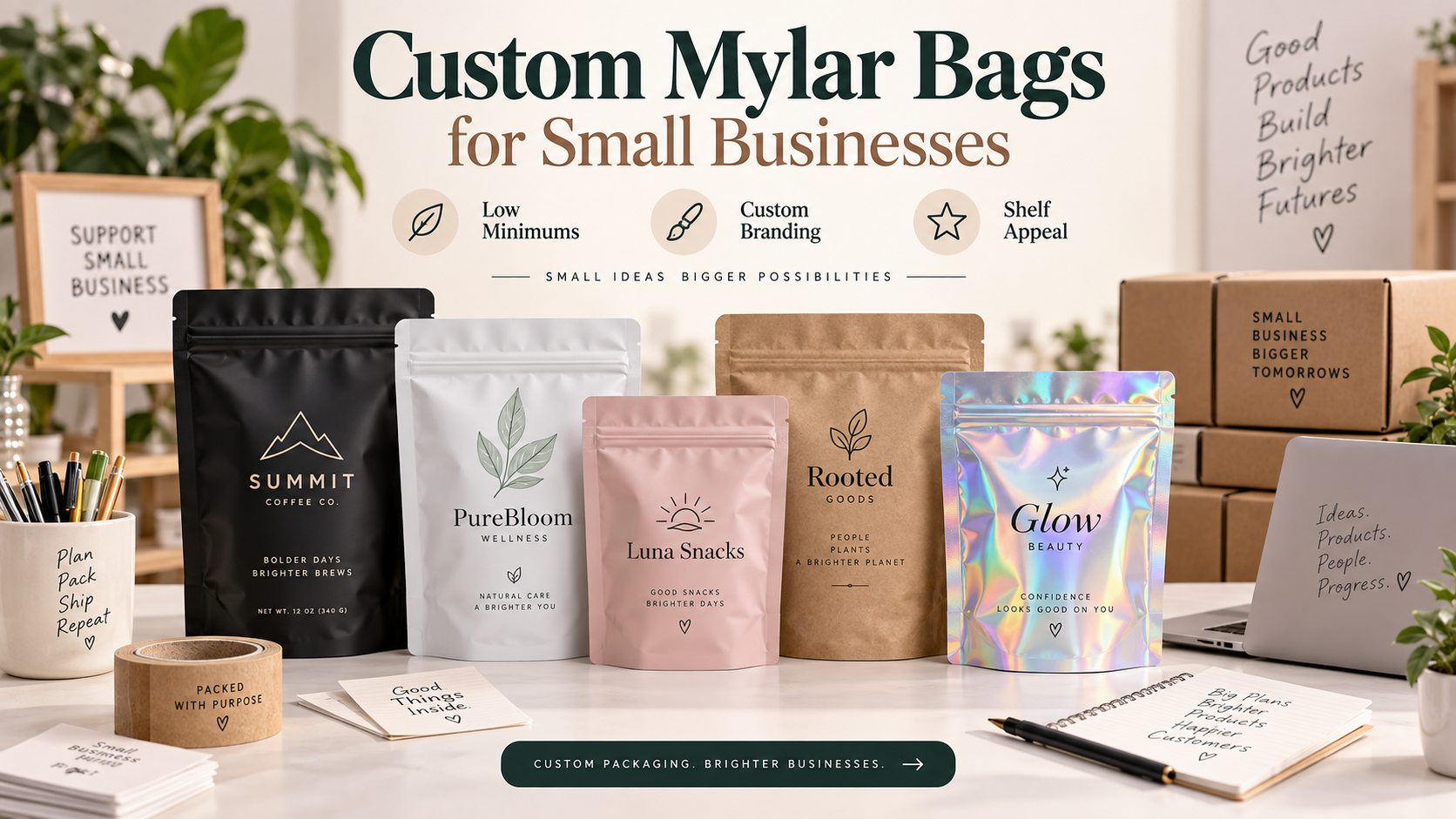

Custom Mylar Bags for Small Businesses: What You Need to Know Before Ordering
Ordering packaging for the first time comes with a learning curve. Most business owners only discover this after getting a quote back. Terms like MOQ, plate fees, and turnaround time get used quickly by suppliers. It is easy to commit to an order before fully understanding what those numbers mean for a smaller operation. Suppliers such as premium mylar bags work with businesses at very different scales. The ordering process looks noticeably different depending on where a business falls on that spectrum. This guide walks through the practical details worth understanding before placing that first custom order.

Printing Methods and Why They Matter
The printing method a supplier uses affects cost, minimum order size, and design flexibility. It shapes almost every other decision in the process.
- Digital printing applies artwork directly onto the film without plates. This suits smaller runs and designs that change often
- Gravure or plate printing uses engraved cylinders for each color. It produces sharp results at high volume but requires upfront tooling costs
- Flexographic printing sits between the two. It offers lower plate costs than gravure while still needing setup for each design
Small businesses testing a new product usually save money with digital printing. It avoids paying for plates that get used once before the design changes again.
Understanding Minimum Order Quantities
MOQ is one of the most misunderstood numbers in custom packaging. It varies widely depending on printing method and supplier setup.
| Printing Method | Typical MOQ | Setup Cost Involved |
|---|---|---|
| Digital, direct-print | 300–500 units | Minimal to none |
| Flexographic | 1,000–3,000 units | Moderate plate fees |
| Gravure/rotogravure | 3,000–8,000 units | $1,000–$3,000+ in cylinder costs |
| Stock bag with printed label | 100 units or fewer | Very low |
A supplier advertising a very low MOQ on a “custom” bag sometimes means something different than expected. The supplier may apply a label to a stock bag rather than printing directly onto the film. That distinction matters, since a labeled stock bag limits design placement compared to direct film printing.
Questions Worth Asking Before Committing
Getting a clear answer on these points upfront avoids surprises once a quote arrives.
- Is the price based on direct film printing or a label applied afterward?
- Are plate or cylinder setup fees included in the quoted unit price, or billed separately?
- What happens if the design changes after plates have already been made?
- Does the MOQ apply per design, or can it be split across multiple SKUs?
- What is the actual turnaround time from artwork approval to shipment?
What Affects the Cost Per Bag
Cost per unit swings widely across the industry. Small businesses often get quotes that look confusing until they break down the underlying factors.
- Order volume, since higher quantities spread setup costs across more units
- Bag thickness and barrier requirements, since heavier films cost more per unit
- Number of print colors and design complexity
- Special features like zippers, valves, or matte or spot-gloss finishes
- Rush turnaround requests, which typically carry a premium
Small orders in the 300 to 3,000 unit range commonly cost between roughly $0.60 and $1.25 or more per bag. High-volume orders above 100,000 units can fall well under $0.20 per bag. That gap exists because larger runs divide setup and tooling costs across far more units.
Preparing Artwork for a Smooth Order
Design files that are not print-ready cause more delays than almost any other part of the ordering process. Suppliers grouping printed, branded options like decorative mylar bags typically expect artwork in a specific format before production begins. Mismatched file types remain one of the most common reasons a first order stalls.
Common artwork requirements include:
- Vector files rather than low-resolution raster images
- Fonts either outlined or embedded to avoid substitution errors
- Color values specified in CMYK rather than RGB for accurate printing
- Bleed and safety margins built into the file to prevent cut-off text or logos
- A proof review step before full production begins
Skipping the proof stage to save time often backfires. Catching an error after printing has started usually means paying for a full reprint.
Choosing the Right Bag Specification
Printing is only part of the decision. The bag itself needs to match the product it will hold. This affects thickness, size, and closure type independently of any branding choices.
- Match thickness to product weight and storage duration rather than defaulting to whatever a previous supplier used
- Choose a closure type, such as a zipper or heat seal, based on how often the end customer will reopen the bag
- Confirm whether a barrier layer is necessary for the product’s shelf-life requirements
- Select a size that fits the product without excess empty space, which affects both cost and shelf presentation
Finish choices also fall under this decision. Some brands go beyond standard matte or gloss and choose holographic mylar bags instead. These shift color under different lighting and tend to draw more attention at the point of sale.
Setting Realistic Turnaround Expectations
Timelines vary based on printing method and order complexity. Small businesses planning a launch date should build in buffer time. Assuming the fastest quoted timeline will always hold rarely works out well.
Typical turnaround windows after artwork approval:
- Digital printing: often 7 to 12 business days
- Flexographic or gravure printing: commonly 12 to 20 business days
- Rush orders: available from some suppliers at an added cost, though not universally offered
Shipping time sits on top of production time. A business working toward a launch date should plan for both stages, not just the production window.
Common Mistakes First-Time Buyers Make
Several issues show up repeatedly with businesses ordering custom packaging for the first time. Most of them are avoidable with a bit of upfront planning.
- Approving artwork without checking bleed margins, resulting in text or logos cut off after printing
- Choosing the cheapest quote without confirming whether setup fees are included separately
- Ordering a quantity based on budget alone rather than actual sales velocity, leading to excess inventory sitting unused
- Assuming all suppliers use the same printing method, then comparing quotes that are not actually equivalent
- Skipping a physical sample request, so the bag only gets a real-world check after full production
Requesting a physical sample before committing to a full run catches most problems early. Color accuracy, material feel, and bag dimensions all show up clearly in a sample.
Building a Relationship With a Packaging Supplier
A first order rarely represents the full relationship with a supplier. Businesses that scale successfully tend to treat that first run as a testing phase rather than a final commitment. They use the experience to judge communication, consistency, and how a supplier handles problems during production.
Signs worth paying attention to during a first order:
- How clearly the supplier explains pricing before requesting payment
- Whether the supplier provides and reviews proofs before mass production starts
- How the supplier communicates delays if the timeline shifts
- Consistency between the sample and the final bulk shipment
A supplier that performs well on a small first order tends to make a stronger long-term partner. Low price alone rarely makes up for limited transparency throughout the process.
Making the First Order Count
A first custom packaging order sets the tone for every reorder that follows. Suppliers who clearly answer questions about printing method, MOQ, and turnaround tend to be far more reliable partners. A few extra questions upfront cost nothing. Skipping them can lead to packaging that does not match what a growing business actually needed.
Leave a Reply