
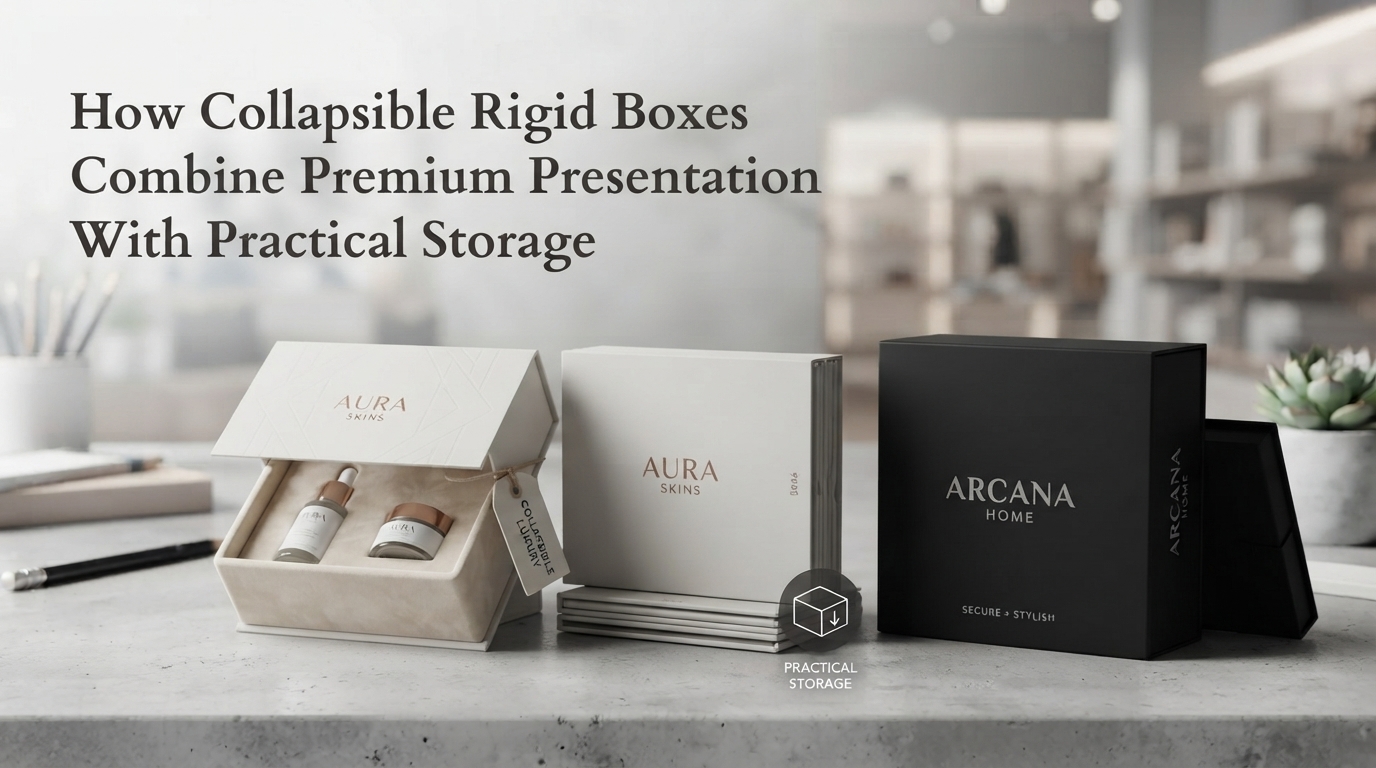

Premium packaging often has to solve two problems at once: how to make a product look impressive and how to make packaging practical for businesses that need to store, transport, and fulfill it efficiently.

Collapsible rigid packaging addresses this challenge by combining the substantial appearance of rigid construction with a format that can be folded down when not in use. This makes it an interesting option for brands that want a premium presentation without overlooking storage and logistics.
For businesses exploring made-to-size packaging solutions, Custom Product Packaging can provide a starting point for evaluating box structure, materials, artwork, inserts, and finishing requirements.
What Are Collapsible Rigid Boxes?
Collapsible rigid boxes are premium boxes designed with a rigid appearance and structure while incorporating a folding mechanism that allows the package to collapse when empty.
Unlike conventional rigid boxes that maintain their full shape during storage, a collapsible design can reduce the amount of space required before the box is assembled for use.
This characteristic can be valuable for brands managing inventory, fulfillment operations, retail storage, or shipping logistics.
At the same time, the package can retain the visual qualities associated with premium rigid packaging, including sturdy construction, customized printing, and decorative finishes.
Why Businesses Consider Collapsible Packaging
Storage space can become a significant operational consideration when packaging is purchased in volume.
Traditional rigid boxes can occupy considerable warehouse space because they remain assembled. Collapsible packaging provides another approach by allowing empty boxes to be stored in a more compact form.
This can help businesses think about packaging from a complete lifecycle perspective:
- Manufacturing
- Storage
- Transportation
- Assembly
- Fulfillment
- Customer delivery
- Product presentation
The packaging is therefore not just a marketing element. It can also influence how efficiently a business handles its inventory.
Premium Presentation Without the Permanent Footprint
One misconception about collapsible packaging is that practicality necessarily means sacrificing appearance.
A well-designed collapsible rigid package can still support premium artwork, branding, and finishing. The exterior can be developed around the brand’s visual identity, while the structure provides a substantial presentation once assembled.
This can make the format suitable for businesses that want a premium unboxing experience while also paying attention to operational efficiency.
For brands comparing wholesale rigid boxes, collapsible construction can be worth considering when storage efficiency is an important part of the packaging decision.
Applications for Different Industries
Collapsible rigid packaging can work across several product categories.
Apparel and Accessories
Premium clothing accessories, scarves, belts, and other products can benefit from a sturdy presentation box that can be stored efficiently before fulfillment.
Cosmetics and Beauty
Beauty brands often rely heavily on packaging to communicate quality. A collapsible rigid structure can provide an upscale presentation for selected product lines and gift sets.
Electronics and Accessories
Smaller electronics and accessories may benefit from customized inserts inside a rigid package. The collapsible format can also make empty packaging easier to store before products are packed.
Jewelry and Gifts
Gift products often require presentation that feels special. Custom artwork, interior layouts, and finishing can help create a more distinctive opening experience.
Promotional and Corporate Kits
Businesses creating branded kits can use collapsible rigid packaging when the package needs to look polished while also being practical for storage and fulfillment.
Custom Sizing Matters
The value of a collapsible package depends partly on how accurately it is designed around the product.
A box that is too large may waste material and create unnecessary movement inside the package. One that is too small may make packing difficult or compromise the intended presentation.
Before production, brands should establish:
- Product dimensions
- Product weight
- Number of items per box
- Insert requirements
- Closure preferences
- Storage conditions
- Shipping method
Accurate measurements can help create a package that balances protection, appearance, and practicality.
Inserts Can Organize the Interior
The inside of a premium package can be customized just as carefully as the outside.
Depending on the product, inserts can help keep individual items in position and create designated spaces for accessories.
Potential insert materials include paperboard, cardboard, foam, or other suitable components based on the product requirements.
For example, a branded gift set could include a primary product, accessory, information card, and promotional material. Instead of allowing these pieces to move freely inside the package, a fitted interior can create a cleaner arrangement.
The insert should serve a practical purpose while contributing to the overall presentation.
Branding Opportunities
The exterior of the package is an important brand touchpoint.
Businesses can use their packaging to reinforce recognizable elements such as:
- Logos
- Brand colors
- Typography
- Product names
- Patterns
- Illustrations
- Photography
- Collection themes
Interior printing can also be considered when the unboxing experience is a major part of the product strategy.
For brands with multiple product lines, a consistent packaging framework can help create visual continuity while allowing individual products to have distinct artwork.
Printing and Finishing
A premium box does not need to rely on excessive decoration.
The printing approach should be selected according to the artwork, quantity, and desired appearance. Once the base design is established, finishing can be used to emphasize selected elements.
Options may include:
- Matte finishes
- Gloss finishes
- Soft-touch surfaces
- Foil stamping
- Embossing
- Debossing
- Spot UV
- Heat-stamped details
For example, a simple logo can be highlighted with a subtle foil treatment while the rest of the package uses a clean matte surface.
This creates contrast without overwhelming the overall design.
The Unboxing Experience
Collapsible rigid packaging can still deliver the deliberate opening experience customers associate with premium packaging.
Once assembled, the structure can be designed around the way the customer discovers the product. The box may open through a lid, drawer, magnetic mechanism, or another suitable configuration depending on the design.
The sequence can be planned to reveal the product gradually.
For ecommerce brands, this can become an important customer touchpoint because packaging is often the first physical interaction a customer has with the brand after placing an online order.
Storage and Fulfillment Advantages
The collapsible characteristic can be especially relevant to businesses with limited warehouse space.
Instead of storing every empty package in its final assembled form, companies may be able to organize collapsed packaging more efficiently.
This can also be useful for businesses that operate multiple fulfillment locations or maintain packaging inventory for seasonal products.
However, the actual space savings depend on the box construction, dimensions, quantity, and storage system. Businesses should evaluate their own operations rather than assuming a particular reduction.
Shipping Considerations
Packaging decisions should account for the entire journey from supplier to customer.
The empty boxes may travel from the packaging manufacturer to a warehouse before being assembled and filled. The finished package may then travel through fulfillment and delivery networks.
Brands should therefore evaluate:
- Box durability
- Product weight
- Internal protection
- Assembly requirements
- Outer shipping packaging
- Storage conditions
- Handling environment
A premium presentation box may still need an additional shipping carton or protective layer depending on the product and distribution method.
Sustainability and Material Efficiency
Packaging efficiency can be considered alongside sustainability goals.
A collapsible format may allow businesses to manage empty packaging more efficiently, while right-sizing can help reduce unnecessary material.
Brands can also explore recyclable paper-based materials where appropriate and consider how inserts, coatings, and finishing affect the overall packaging system.
Sustainability should be evaluated across the complete lifecycle rather than based on one material characteristic alone.
Common Mistakes to Avoid
Choosing Collapsible Packaging Only for Appearance
The main advantage of the format may be operational as much as visual. Brands should evaluate storage and fulfillment needs before making a decision.
Ignoring Assembly
If employees need to assemble boxes before fulfillment, the process should be practical and repeatable.
Using Inaccurate Measurements
Product dimensions should be verified before the packaging structure is finalized.
Overdesigning the Box
A premium appearance comes from balance. Too many finishes can make the package look busy.
Forgetting Shipping Protection
The presentation box may require additional external protection during delivery.
How to Plan a Collapsible Rigid Packaging Project
A structured process can make packaging development easier.
Step 1: Define the product.
Record dimensions, weight, fragility, and the number of components.
Step 2: Establish the packaging objective.
Decide whether storage efficiency, presentation, protection, or a combination of these is the main priority.
Step 3: Select the structure.
Determine the appropriate collapsible configuration and opening style.
Step 4: Plan the interior.
Identify whether inserts, compartments, or dividers are required.
Step 5: Develop artwork.
Prepare exterior and interior branding around the final structural dimensions.
Step 6: Select finishes.
Choose decorative treatments that support the brand identity.
Step 7: Evaluate logistics.
Consider storage, assembly, fulfillment, and shipping.
Step 8: Review a sample.
A physical prototype can help evaluate fit, structure, artwork, and usability before production.
Frequently Asked Questions
1. What are collapsible rigid boxes?
They are rigid-style presentation boxes designed with a folding structure that allows them to collapse when empty, making storage and handling more practical.
2. Are collapsible rigid boxes suitable for premium products?
Yes. They can support customized artwork, branding, inserts, and premium finishing while maintaining a substantial presentation.
3. Can collapsible rigid boxes be customized to fit a product?
Yes. The box dimensions can be developed around the product’s size, weight, internal components, and presentation requirements.
4. Can inserts be used inside collapsible rigid packaging?
Yes. Inserts can be incorporated to position products, separate components, and create a more organized interior presentation.
5. Are collapsible rigid boxes useful for ecommerce businesses?
They can be useful for ecommerce brands that want premium presentation while also considering packaging storage, fulfillment, and inventory management.
Conclusion
Collapsible rigid packaging offers an interesting balance between premium presentation and practical packaging management. Its ability to fold down when empty can make storage and handling more convenient, while the rigid-style construction can support a polished customer experience.
The best results come from considering the entire packaging process rather than focusing only on appearance. Product dimensions, structure, inserts, branding, finishes, storage, assembly, and shipping should all be evaluated before production.
For brands looking to combine presentation with operational practicality, collapsible packaging can provide a versatile option for products, gift sets, promotional kits, and ecommerce fulfillment.
Leave a Reply